
Introduction
For many Singaporeans, the decision between Joint Tenancy and Tenancy in Common is often overlooked until a dispute or a death occurs. When purchasing property in Singapore, the chosen “manner of holding” is more than just a formality—it dictates ownership shares and inheritance rights.
- Understanding Manner of Holding
- Joint Tenancy: Characterized by the right of survivorship. Co-owners are considered a single entity with equal, undivided interests. If one owner passes away, their interest automatically transfers to the surviving owner(s), regardless of any instructions in a will. This is common for married couples seeking a seamless transfer of the family home.
- Tenancy in Common: Owners hold delineated shares (either equal or unequal). There is no right of survivorship; instead, an owner’s share is distributed according to their will or the Intestate Succession Act 1967. This is often preferred by investors or business partners who wish to retain individual control over their stake.
- How to Sever a Joint Tenancy
Severance converts a Joint Tenancy into a Tenancy-in-Common. In Singapore, intention alone is insufficient. Co-owners must follow specific legal pathways:
I. By Mutual Agreement (Consensual): The most straightforward method, where all joint tenants formally agree to the severance.
II. By Unilateral Declaration (Non-Consensual): A joint owner can sever the tenancy without the other’s consent, provided they strictly comply with the requirements of the Land Titles Act (LTA) or the Conveyancing and Law of Property Act (CLPA).
III. By “Operation of Law” (Common Law): Certain actions trigger automatic severance:
o Alienation: Selling or mortgaging a “share” to a third party.
o Bankruptcy: If a co-owner is declared bankrupt, the bankrupt’s interest vests in the Official Assignee.
o Court Order: In matrimonial proceedings, the Family Justice Court may order the severance of the home.
- Case Study: Chan Lung Kien v Chan Shwe Ching [2018] SGCA 24
The Court of Appeal clarified that for registered land, informal or equitable arrangements are insufficient.
The Facts:
The case centered on a residential property located at 9 Jalan Tanah Rata, held by a husband and wife as joint tenants. The husband, Mr. Lim attempted to “sever” this joint tenancy into a tenancy-in-common. This would have given him a distinct 50% share that he could control independently. However, his attempt hit two major legal roadblocks that eventually led the Court of Appeal to declare his actions ineffective.
The court had to decide if Mr. Lim’s actions— a public notice in a newspaper and a standard certificate of posting—were enough to sever the joint tenancy under the Land Titles Act (LTA).
The Court found that the attempted severance by Mr. Lim was ineffective for two primary reasons:
- Failure to Register: The instrument of declaration was never registered with the Singapore Land Authority.
- Improper Service: Mr. Lim failed to comply with the service requirements of section 53(5), which mandate service “personally or by registered post”. He instead used a certificate of posting and a newspaper advertisement, neither of which satisfied the statute.
Overruling Diaz Priscilla v Diaz Angela [1997]SGCA 55:
Crucially, the Court of Appeal in Chan Lung Kien’s case overruled the previous decision in Diaz Priscilla’s case, which suggested that severance could occur when the instrument is served on the other joint tenant and registration is not a prerequisite to severance. The Court of Appeal reaffirmed that for registered land, the Land-register is the definitive record. A three-step process (Execution – Service – Registration) is mandatory.
- Statutory Requirements: LTA vs. CLPA
Let’s compare the different process depending on whether the land is registered under the Torrens system or Common Law.
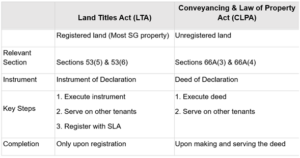
I conclude by highlighting some practical implications and considerations:
- Stamp Duties: Converting from Joint Tenancy to Tenancy-in-Common in equal shares generally does not incur Buyer’s Stamp Duty (BSD) or Additional Buyer’s Stamp Duty (ABSD). However, if the conversion results in unequal shares, stamp duties may apply to the portion being transferred.
- HDB Flats: HDB owners must follow a specific administrative process via the HDB Branch or e-Service. HDB facilitates the change in the manner of holding directly.
- While unilateral severance is possible, it is always tactically better to attempt a mutual agreement first to preserve family relationships.
The Bottom Line: Under the Torrens system, the purpose of the Land-register is to display the ownership and all dealings with registered land. If a severance is not registered, the law will continue to treat the owners as joint tenants.